On this page
For the security reviewer:
what Verosek sees, keeps and seals.
Verosek is a gateway: your application's model calls, and the tool calls the model proposes, pass through it, and it applies each key's rules and records each request. Here are the answers to a security review's first questions.
What sits in the path, and what passes through it?
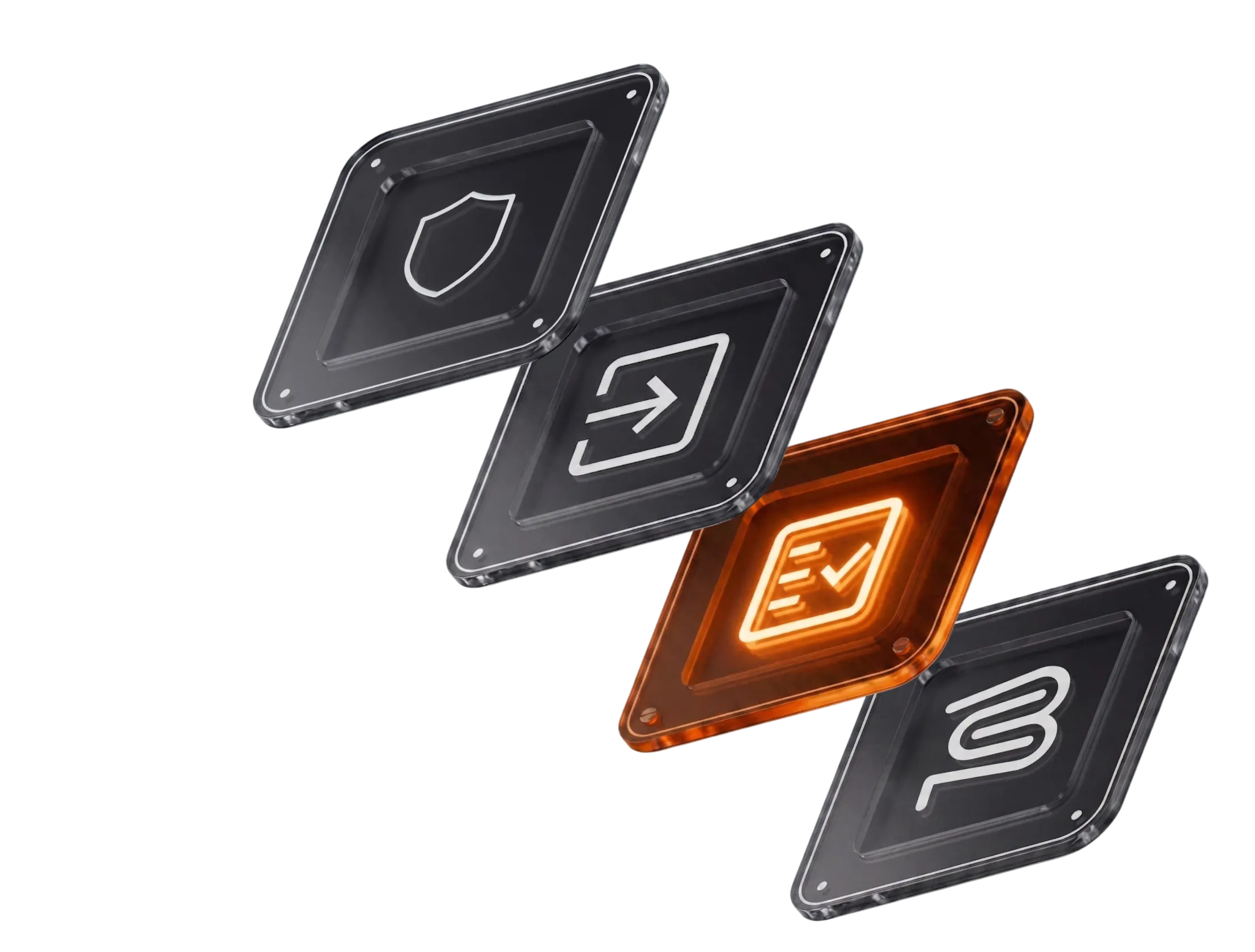
The gateway sits between your code and the model providers and tool servers it calls, and it reads what passes through: prompts, replies, tool arguments and tool results. It checks the key, scans the input once Shield is enabled, routes to one of your deployments, judges each tool call the model proposes, scans the output and seals a trace.
- OpenAI, Anthropic or Gemini SDK
- An MCP client
- Key checked
- Input scanned
- Routed
- Tool calls judged
- Output scanned
- Trace sealed
- Model providers you configured
- MCP servers you connected
What does Verosek store, and for how long?
Verosek stores its configuration, an admin audit log, the input and output of background agent tasks, and a trace of each request, with secrets and personal data scrubbed from the trace's text. A trace keeps short pieces of text, not the whole of it. Team keeps audit records for 30 days, and Enterprise keeps them for 90 days or more, on custom terms.
Where do credentials and keys live, and who can read them?
Provider keys and connection credentials are encrypted at rest with AES-256-GCM and never returned by the API, so an admin can replace one and cannot read it back. A virtual key is shown once and stored only as its hash. On a self-hosted deployment, on the Enterprise plan, you hold the keys that encrypt credentials and seal records.
What happens when a check, a provider or the record fails?
By default, a blocking rule that cannot run before text is released refuses the request, and a request the record cannot hold is refused before anything runs. A check that only flags lets the text through and reports it, in the response or the record. When a provider fails, chat calls fall back in priority order among your organisation's deployments.
What is sealed, and who can check it?
Each request's trace is sealed with HMAC-SHA256, and a sealed record fails its check once someone without the key changes it. An admin or an auditor can ask the gateway to check a trace. On a self-hosted deployment, an auditor holding the verification key can check one offline with one command, with no call back to Verosek. For anyone else, decisions go to a signed log a third party can check with public keys.
Who can change a rule, and how is that recorded?
An admin can change a rule, and so can a service token you gave that right, and the admin audit log records who made a change, when and what moved. Roles are super admin, admin, auditor and user. An auditor and a user can read traces and cannot change a key, rule or connection.
What leaves the deployment, and what calls home?
On an Enterprise deployment in your environment, model calls go to the providers you configure and tool calls go to the servers you connect. The gateway holds no licence check, telemetry or call to a Verosek host. Test it on your own network.
What should you know before you deploy it?
- It acts only on what passes through it, so a call that goes around it is not seen, decided or recorded.
- Run the MCP servers it launches under your own isolation, as you would any third-party code.
- Shield scans once you enable it.
- The gateway is closed source. Assay, the MCP security benchmark we maintain, is MIT-licensed.